Circuits, gradients, and variational templates
Qiskit circuits, PennyLane gradients, mini VQC loop
The Problem
What practitioners underestimate
Even “fully quantum” variational algorithms spend most of wall-clock time in classical pre- and post-processing: transpilation, batching of shots, gradient accumulation, trust-region or Adam steps on parameters, logging, and checkpointing.
This chapter spends time on both Qiskit circuit composition and PennyLane’s differentiable execution before it frames chemistry or finance. The transferable skill is reading expectation traces and gradient norms as engineering signals.
You should leave this chapter able to
- Construct a small parametrised circuit and verify it on a simulator.
- Compute gradients of expectation values with respect to gate parameters.
- Relate those gradients to an outer minimisation loop you could swap for business metrics later.
The Challenge
Depth, noise, and barren plateaus
The Challenge
Why shallow templates appear first
Deep unstructured ansätze are difficult to train under sampling noise. The workshop materials keep compact entangling layers so you can still interpret gradient magnitudes and loss curvature.
When you later connect to chemistry Hamiltonians, the same caution applies: more parameters do not automatically mean a better variational state. Subspace methods (SQD and relatives) exist precisely because full Hilbert-space paths are intractable.
Red flags during training
The Solution
One mini VQC training loop
The Solution
Pattern shared by VQE and QAOA
Choose parameters θ, prepare |ψ(θ)⟩, measure a cost operator (Hamiltonian for VQE, problem Hamiltonian for QAOA), feed the estimate to a classical optimiser, iterate. The companion code makes that loop tangible with a toy cost so the plumbing is visible.
Chemistry as motivation, not magic
Molecular Hamiltonians are genuine examples of the same pattern: Pauli sums that you measure term by term. Business QUBOs are different in origin but identical in the classical outer loop structure.
Implementation
PennyLane expectation + classical step
Implementation
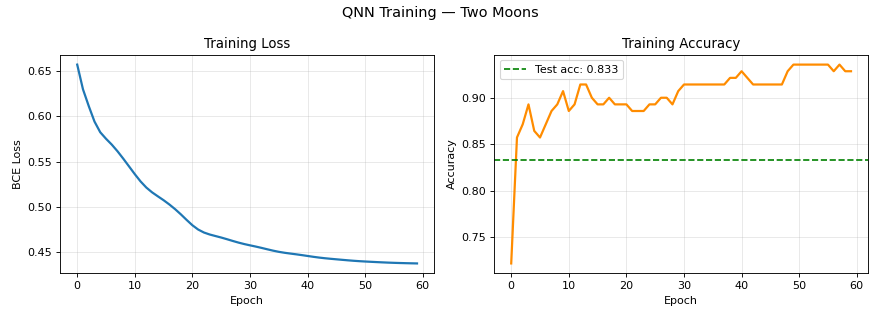
The excerpt mirrors the hybrid training pattern: a qnode returns an expectation, and PyTorch (or another AD framework) handles θ updates.
Swap PauliZ(0) for a Hamiltonian sum when you move to VQE; keep the outer loop identical.
import pennylane as qml
import torch
from torch import nn, optim

dev = qml.device("default.qubit", wires=n_qubits)

@qml.qnode(dev, interface="torch", diff_method="backprop")
def circuit(x, theta):
    qml.AngleEmbedding(x, wires=range(n_qubits))
    qml.StronglyEntanglingLayers(theta, wires=range(n_qubits))
    return qml.expval(qml.PauliZ(0))

theta = nn.Parameter(0.01 * torch.randn(depth, n_qubits, 3))
opt = optim.Adam([theta], lr=0.05)

for batch_x, batch_y in loader:
    preds = torch.stack([circuit(x, theta) for x in batch_x])
    loss = torch.nn.functional.mse_loss(preds, batch_y)
    opt.zero_grad()
    loss.backward()
opt.step()Summary
Carry the outer loop discipline forward
Summary
What to remember
Treat quantum modules as differentiable building blocks with the same logging standards as any neural submodule. If gradients vanish or shots explode, fix that before claiming domain advantage.
The next three chapters apply the same hybrid stack to a classifier, a finance portfolio, and a logistics route. The circuit skills here are the glue that keeps those later parts honest.
Continue this saga
Next chapter: Hybrid classifier stack.