Hard problems as bitstrings
Subset sums, tours, satisfiability, one pattern
The Problem
What this chapter makes explicit
Subset sums, travelling tours, and logical clauses look unrelated on a slide deck. They share a computational skeleton: choose an assignment of zeros and ones, evaluate a cost or constraint violation, reject infeasible strings, and compare against classical search or integer programming.
Quantum heuristics enter only after that skeleton exists. If stakeholders cannot explain what each bit means operationally, no device, classical or quantum, can rescue the project.
Concrete questions before any circuit diagram
- Which bits encode a feasible decision versus an auxiliary slack variable?
- What single scalar summarises quality for feasible assignments?
- Which classical solver or enumerator defines the baseline on the same encoding?
The Challenge
Sampling is not optimisation
The Challenge
Where teams get surprised
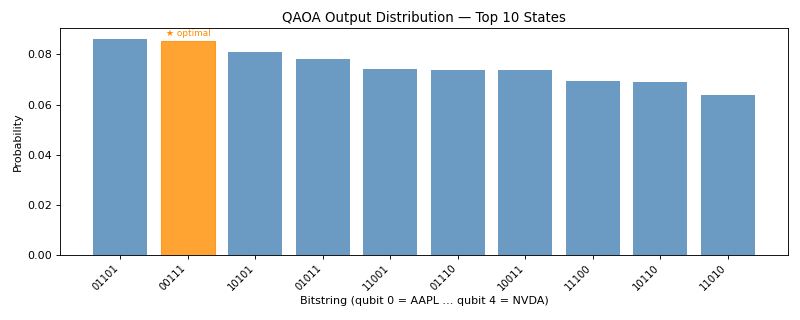
Heuristic samplers, quantum or classical, may concentrate probability on good bitstrings without placing most mass on the global optimum. That behaviour is not automatically a bug; it is a reason to report full histograms or energy bands instead of a single headline draw.
Another common gap is forgetting feasibility: a low-energy string under a relaxed penalty model can still decode to an illegal business decision. Classical verification after readout is part of the algorithm, not an embarrassment.
Keep the evaluation honest
The Solution
Encode, score, sample, verify
The Solution
Pipeline narrative
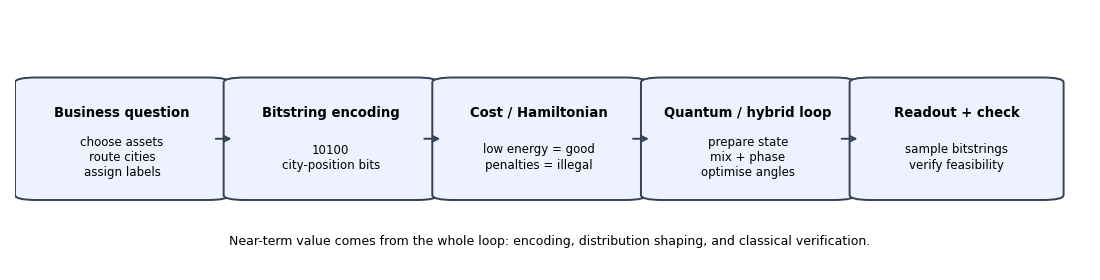
The same four-stage pipeline is visualised for portfolio-style problems and for routing: variables → Hamiltonian or pseudo-Boolean cost → sampler that shapes a distribution → classical decoder that checks constraints and business logic.
The diagram below is intentionally generic. Treat it as the contract between domain experts and algorithm engineers: every arrow must have an owner and a test.
Implementation
Feasibility-aware evaluation pattern
Implementation
The companion workshop walks subset sum, TSP, and 3SAT with small visual sanity checks. The code sketch below shows the shape of a feasibility-aware evaluator: decode bits, reject violations, then score only legal candidates.
Pair with a classical brute check on tiny n before trusting any sampler.
import math

def tour_length(bits, dist, n_cities):
    # bits encode a permutation or one-hot layout depending on your QUBO
    path = decode_tour(bits, n_cities)
    if not is_valid_permutation(path):
        return math.inf
return sum(dist[path[i]][path[i + 1]] for i in range(n_cities))Summary
Numbers that travelled from the older evidence pack
Summary
Portfolio sampler versus exact QUBO sweep
When the same five-asset toy QUBO is scored with a variational QAOA-style loop versus an exhaustive classical sweep, one recorded pair of costs is about −3.62 (variational) versus −9.40 (best feasible classical). The gap illustrates sampler bias, not a universal law.
How to reuse the figure
The landscape plot below is still useful as a teaching artefact: it shows how often sampled energies land near good portfolios. Use it to discuss exploration versus exploitation, not as a competitive benchmark without hardware context.
Continue this saga
Next chapter: Circuits, gradients, and variational templates.